
Educational Resources & Historical Truths
On March 25, 2026, the United Nations General Assembly adopted a historic landmark resolution introduced by a coalition of African, Caribbean, and Latin American nations.
A Global Reckoning:
The UN Resolutionon the Transatlantic Slave Trade
The resolution officially declares the transatlantic slave trade "the gravest crime against humanity" due to its definitive break in world history, immense scale, brutal nature, and the enduring systemic consequences that continue to impact descendants globally today.
While the resolution passed with a significant majority of 123 votes in favor from the Global South, the political West largely refused to formally condemn it—with the United States, Israel, and Argentina casting votes directly against the measure, and the European Union, United Kingdom, and Canada abstaining.
The FrameworkforJustice &. Accountability
- The Repercussions of Colonial Exploitation: The resolution explicitly emphasizes that the systemic trafficking and chattel enslavement of African people stripped victims of their basic humanity, names, and rights. The generational repercussions of this exploitation reverberate cleanly into the modern era, manifesting as deeply entrenched structural violence, modern anti-Black racism, and persistent socioeconomic inequities.
- The Framework for Reparative Justice: Central to the resolution is a global call for meaningful restorative justice, including formal apologies, the consideration of systemic reparations, and the restoration of stolen property. Acknowledging these historical wrongs at an international legislative level is framed not merely as a legal debate, but as a mandatory first step toward societal healing and ensuring non-recurrence.
From Global Systems to Local Reality
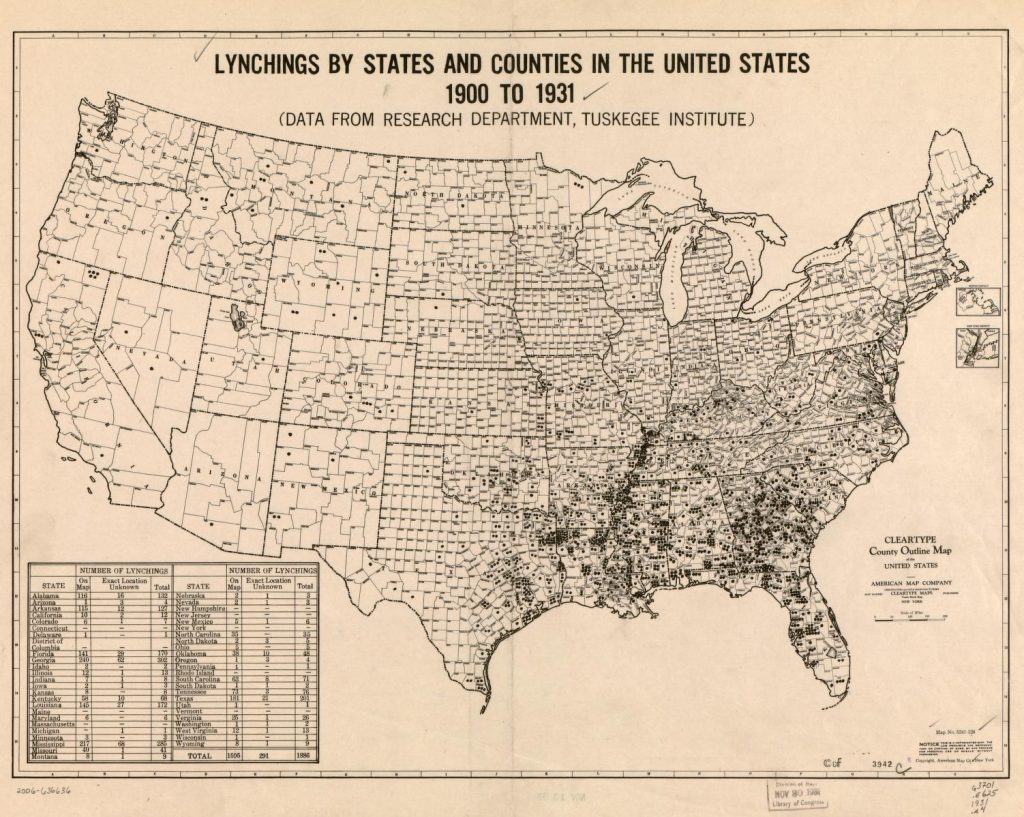
Mapping Racial Violence in the United States
The refusal to uniformly condemn this global history directly mirrors the domestic struggles for legal accountability within the United States. This map network highlights just a fraction of the many documented incidents of racial violence that have taken place across the United States from the 19th century into the modern era.
Each location represents a moment where Black communities faced organized violence, often with little to no legal accountability for those responsible. While the maps cannot capture the full scale of history, they serve as a reminder of how widespread and systemic these events were.

Historical Context & Chronology
1863: The New York City Draft Riots
In 1863, New York City witnessed the Draft Riots, one of the deadliest urban uprisings in American history. What began as protests against military conscription quickly turned into targeted violence against Black residents. Homes were burned, people were assaulted and killed, and entire communities were forced to flee. It revealed how racial tensions could erupt violently even in northern cities.
1898: The Wilmington Coup (North Carolina)
In 1898, Wilmington, North Carolina experienced what is often described as the only successful coup in United States history. A multiracial local government was overthrown by white supremacists through violence and intimidation. Black citizens were killed, elected officials were removed, and many families were forced to leave the city. This event reshaped political power in the region for decades.
1917–1919: The East St. Louis Massacre & The Red Summer
The early 20th century saw multiple large-scale attacks. In 1917, the East St. Louis Massacre resulted in widespread destruction and loss of life as white mobs targeted Black workers and residents. In 1919, known as the Red Summer, violence spread across several cities including Chicago and Elaine, Arkansas. In Elaine, hundreds of Black sharecroppers were killed after attempting to organize for fair wages. These events showed how economic and racial tensions often intersected with deadly consequences.
1921: The Tulsa Race Massacre
In 1921, the Tulsa Race Massacre devastated the Greenwood District, a thriving Black community often referred to as Black Wall Street. Over the course of two days, homes and businesses were destroyed, and many residents were killed or displaced. For decades, the event was largely omitted from mainstream historical narratives, highlighting how easily such histories can be erased or ignored.
1920–1943: Continuous Patterns of Displacement
Other locations on the map, such as Rosewood in 1923 and Ocoee in 1920, reflect similar patterns of violence where entire Black communities were attacked, leading to displacement and long-term economic and social consequences. Even in later years, events like Detroit in 1943 show that racial violence did not simply disappear but continued to shape American cities.
Moving Forward: Conversations on Truth and Justice
Understanding these moments is important not only for historical awareness but also for recognizing patterns. These were not isolated incidents. They were part of a broader system in which racial inequality was enforced through both law and violence.
Acknowledging this history allows for more honest conversations about justice, accountability, and the long-lasting impact these events have had on communities across generations.